.png)
I Spent 90 Days Testing 185+ AI Skills. Here's What Actually Changed How I Work.
A breakdown of the workflows that actually moved the needle: outbound pipelines, GEO audits, parallel subagents, operational intelligence, memory systems, and disciplined execution.
Everyone’s talking about AI. Very few people are actually building with it — methodically, deliberately, and in a way that sticks past the first week of novelty.
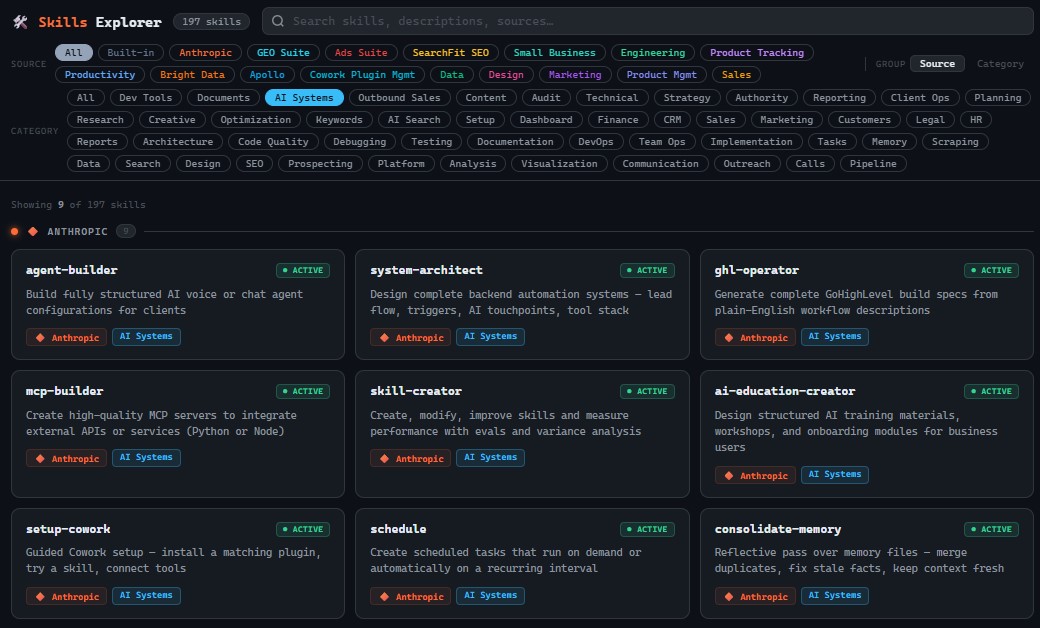
Over the past 90 days, I went heads-down and built 185+ specialized AI skills inside Claude. They include custom workflows for outbound sales, client reporting, advertising strategy, SEO, financial analysis, engineering, and a dozen other domains.
Some were experiments. Some flopped. But a handful fundamentally changed how I operate in ways I didn’t anticipate when I started.
This isn’t a hype post. This is a breakdown of what actually moved the needle — and why.
The Setup: What Is a “Skill,” Anyway?
Think of a skill as a repeatable, specialized AI workflow — not just a prompt, but a structured system that knows what to ask, in what order, and what to do with the answers.
Each one is built around a specific job to be done:
- Audit a contractor’s website
- Generate a 3-step DM sequence
- Produce a PDF ad strategy report
- Build a GoHighLevel automation spec
When I started, I had maybe 30 of these. Now I have 185+, spanning 17 different source categories.
The difference between having 30 and having 185 isn’t just volume — it’s coverage. There’s almost no client task I encounter now where I’m improvising from scratch.
The 6 Workflows That Actually Changed Everything
1) The Full Outbound Lead Pipeline (in under 10 minutes)
This one still surprises me every time I run it.
I drop a contractor’s URL into an audit skill and get a scored breakdown of their website: conversion gaps, trust issues, missing lead capture, load speed problems — framed around business impact (missed calls, lost jobs) rather than design opinions.
A second skill layers in their social presence: Google Business Profile health, review sentiment, Instagram presence.
From there:
- A third skill recommends the right offer based on the gaps
- A fourth generates a personalized DM sequence, cold email, and follow-ups — all referencing the exact weaknesses found in the audit
What used to take 2–3 hours now takes 8–12 minutes — and it’s more targeted than what I was producing by hand.
2) GEO Audits — Optimizing for AI Search, Not Just Google
Generative Engine Optimization (GEO) is about getting content cited by AI systems (ChatGPT, Claude, Perplexity, Gemini) — not just ranked by Google.
I built a GEO audit suite with skills covering:
- AI citability scoring
llms.txtgeneration- structured data
- crawler access analysis
- platform-specific optimization for major AI search engines
The insight that reshaped how I think about content:
AI models don’t rank pages. They quote passages.
The question isn’t “does this page rank?” — it’s “would an AI confidently cite this as a source?”
Those are different problems, and most websites are completely unprepared for the second one.
3) Parallel Subagents for Ad Strategy
This is the one I demo most when people ask what “AI actually doing work” looks like.
You give it a URL. It spins up five parallel subagents:
- audience personas
- competitive ad intelligence
- funnel architecture
- creative concepts
- budget model
They run simultaneously and synthesize into a unified strategy with a composite Ad Readiness Score.
This isn’t AI as “faster execution.” It’s AI doing parallel, multi-angle analysis that wasn’t possible before — not because I lacked the knowledge, but because I only have one brain and one set of hours.
4) The Small Business Intelligence Layer
I underestimated this category when I started building it — then it became one of the biggest compounding wins.
For most small business owners, the blocker isn’t ambition — it’s bandwidth.
They can’t get a real-time read on their business because pulling the picture together takes hours they don’t have.
A Monday morning briefing that synthesizes cash position, sales trends, pipeline movement, and overdue items into a one-pager? That’s not a nice-to-have. It’s the difference between running your business and being run by it.
5) Memory That Actually Persists
One of the subtle but compounding wins: building a real memory system.
The memory management skill maintains a two-tier context layer:
- a working memory file for current projects
- a deeper knowledge base for business context, client details, terminology, preferences
When I’m writing outreach for a roofing client in Phoenix versus an HVAC contractor in Milwaukee, Claude knows the difference. It knows my offer structure, pricing, and tone. It isn’t starting from zero every session.
This sounds small. It’s not. Eliminating the cognitive overhead of re-explaining context every time you open a new conversation is death by a thousand cuts. Removing it changes everything.
6) Engineering + Product Tracking (The Category I Didn’t Expect to Need)
I added an engineering suite (architecture decision records, code reviews, debugging workflows, incident response, deploy checklists).
And I built a product tracking suite covering the telemetry lifecycle: modeling, auditing current tracking, designing tracking plans, generating instrumentation guides, and implementation.
I’m not primarily an engineer — but I build technical systems. Having disciplined skills for these domains means I can move through technical work with structure instead of improvisation, and produce deliverables that would normally require a specialist.
What I Got Wrong at the Start
I thought the value was in having more skills. It’s not.
The value is in the system:
- how skills connect
- how context flows between them
- how consistently you reach for them instead of starting blank
The first 30 skills I built were mostly one-offs. I’d build something, use it once or twice, then forget it existed.
The shift happened when I started thinking in pipelines:
audit → offer → outreach → follow-up → proposal → intake
Each step informs the next. The skills become a workflow, not a collection.
The Honest Takeaway
AI isn’t going to replace the thinking.
What it replaces is the time tax on execution — the hours spent on research, first drafts, reformatting, and repetitive structure that doesn’t require your best judgment but quietly eats it anyway.
Over the past 90 days, I’ve gotten back a meaningful amount of that time.
More importantly: I’ve raised the floor on what I deliver. The worst thing I produce now is better than the average thing I produced before — because structure, research, and sequencing are baked in.
If you’re AI-curious but haven’t gone deep yet:
- Pick one workflow that costs you real time every week
- Build a skill around it
- Use it 10 times
- Then build the next one
That’s the only way this actually changes anything.
What I’m Building
I’m building Vision Venture AI — helping contractors and small businesses implement AI systems that generate leads, follow up automatically, and run without them having to think about it.
If you’re curious what this looks like in practice, reach out.