.png)
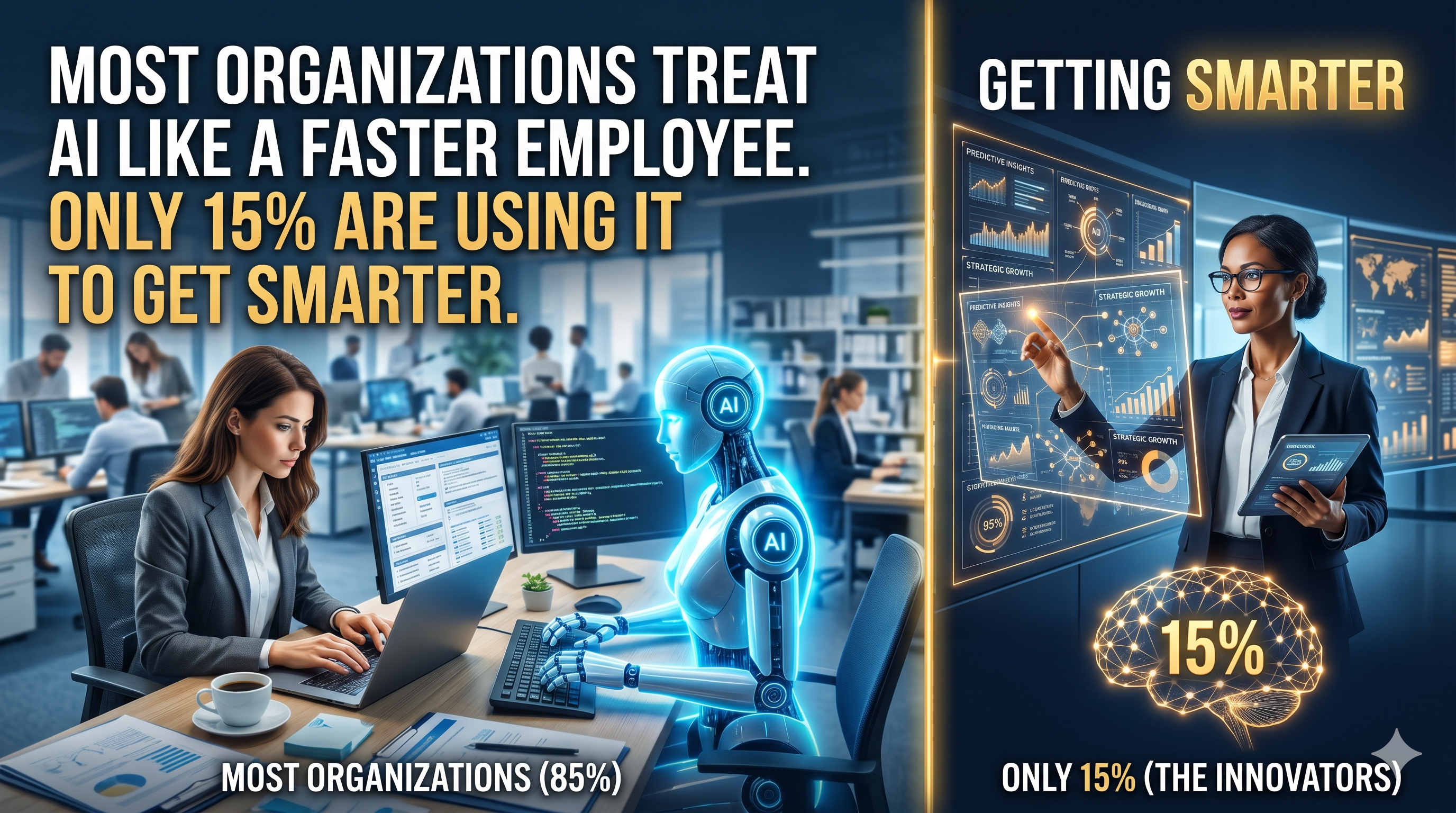
Most Organizations Treat AI Like a Faster Employee. That's Why Their Results Are Disappointing.
Why most AI rollouts stop at speed gains, and what learning infrastructure organizations need to turn adoption into compounding returns.
70% of companies have adopted AI. Only 15% are using it in a way that makes the organization smarter over time. The other 85% are getting faster. They're not getting better.
That gap - between adoption and compounding - is the most important thing happening in enterprise AI right now. And it's almost entirely invisible to the companies on the wrong side of it.
The tool trap
When most organizations deploy AI, they're solving a throughput problem. Too many emails, too much research, too many first drafts. AI handles the volume. Humans move faster. Dashboard metrics improve.
This is what I'd call consumption mode: task in, output out, loop closes. Each interaction is discrete. The AI does work. The human moves on. The next interaction starts from exactly the same place as the last one.
It's not a bad model. It delivers real value. But it's a tool model - the same economic logic as buying a faster computer. You get the speed. You don't get the learning.
The organizations pulling ahead aren't running a faster version of this model. They're running a fundamentally different one.
Consumption vs. compounding
The distinction shows up in what happens after the output.
In consumption mode: verify the output, use it, close the loop. Done.
In compounding mode: verify the output, evaluate what it reveals, capture what should change next time. Then use it.
Three steps versus one. The difference sounds minor. Over six months, it's the difference between an AI deployment that's static and one that's getting measurably better at your specific context - your workflows, your standards, your edge cases.
The research on this is direct. Organizations with systematic human-AI feedback loops are 6x more likely to derive substantial financial benefits from AI. Organizations that invest in learning with AI - not just from it - are 73% more likely to achieve significant financial impact.
The mechanism isn't mysterious. Feedback loops that close create compound returns. Feedback loops that don't close create linear ones, at best.
Why most teams skip steps two and three
It's not laziness. It's measurement.
If you adopted AI to go faster, you measure speed. The tool delivers speed. The dashboard looks fine. No alarm goes off when the feedback loop is missing.
Meanwhile, the 15% running compounding mode are making every cycle more effective than the last. Their prompts get sharper. Their agents develop context. Their systems encode what "good" looks like for their specific operation. That institutional knowledge isn't in a document - it's embedded in the system itself.
You can't catch up to this by going faster. You close the gap by changing the model.
The infrastructure you actually need
Most AI adoption plans focus on tool selection and use case identification. Those matter. But they're the wrong bottleneck.
The bottleneck is the learning infrastructure: the system that captures what worked, what didn't, and how the next cycle should be different. Without it, every interaction starts from zero. With it, the organization's capability compounds.
This comes down to three connected steps - what MIT Sloan's research calls the verify-evaluate-capture flywheel:
Verify
Did the output meet the standard?
This is the quality gate. Most teams do this.
Evaluate
What does this output - good, bad, or mediocre - reveal about how we're using the system?
This is the diagnostic step. Almost no teams do this systematically.
Capture
How does this change the next cycle? What gets updated - the prompt, the agent instructions, the evaluation criteria, the workflow?
This is where compounding happens. And it requires infrastructure, not just intention.
The flywheel only works when all three are connected. Verify alone is quality control. Verify plus evaluate is diagnostics. All three together is a learning system.
What this looks like in practice
I've been building this into AI systems I deploy - agents, workflows, skill stacks - for about a year. The most concrete implementation is an evaluation log: every significant AI-assisted output gets a structured entry that captures what the system did, whether it met the standard, what the failure mode was if it didn't, and what should change.
It's not bureaucracy. It's the infrastructure that makes the next deployment faster to configure, easier to trust, and more likely to produce what you actually want.
The difference between a first-time agent build and a fifth is mostly the result of captured learning. Without the log, you're rebuilding from intuition every time. With it, you're starting from encoded experience.
This is also what separates an AI deployment from an intelligence environment - a system where human and artificial intelligence interact, adapt, and compound over time. The deployment is a starting point. The environment is what makes it valuable six months later.
The question that reveals which model you're running
Ask your team: "What has our AI deployment taught us about how we work?"
If the answer is "it's faster," you're in consumption mode.
If the answer includes specific changes you've made to how you use the system, specific failure modes you've diagnosed and fixed, and specific improvements in output quality you can point to, you're building something that compounds.
The 15% of organizations getting outsized returns from AI aren't smarter about technology. They're smarter about learning. They treat every AI interaction as an input to a system that should be getting better, not just an output to be consumed.
That framing shift - from tool to learning system, from throughput to compounding - is the whole game.
What I'm building
I build AI systems for healthcare organizations and, through Vision Venture AI, for home service contractors. The pattern holds across both: the organizations that get durable returns are the ones that treat the feedback loop as infrastructure, not an afterthought.