.png)
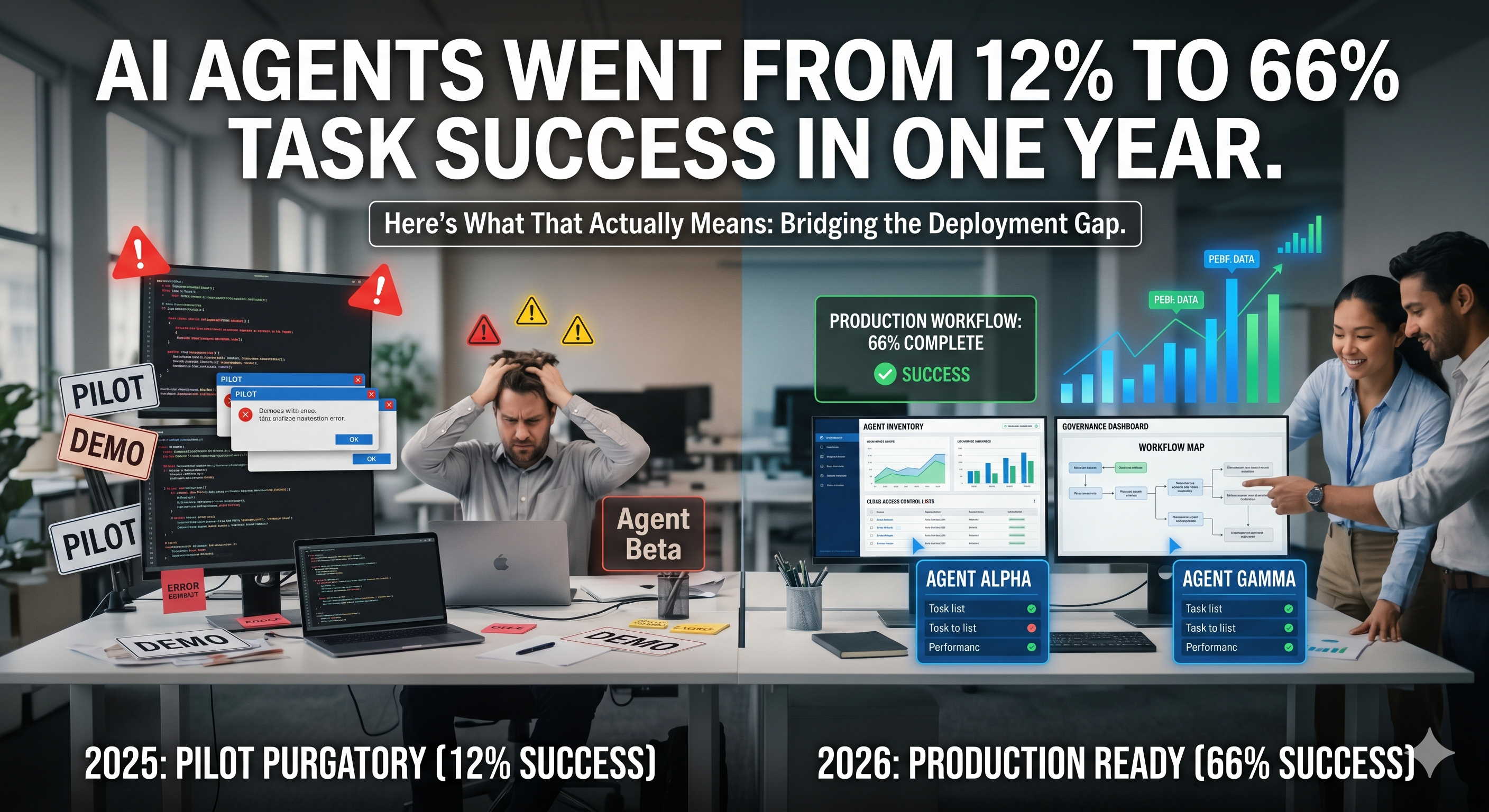
AI Agents Went From 12% to 66% Task Success in One Year. Here's What That Actually Means.
Why the jump in agent benchmark performance matters less than the operational infrastructure required to deploy that capability in production.
Stanford's 2026 AI Index dropped a number that should have stopped every operator in their tracks: AI agent task success on real computer work jumped from 12% to 66% in a single year.
That's not a benchmark on cherry-picked demos. That's on actual tasks - opening files, navigating apps, completing multi-step workflows.
Human performance on those same tasks sits around 72%. Agents are six percentage points away.
Still, AI models can win a gold medal at the International Mathematical Olympiad but still can't reliably tell time, illustrating what researchers call jagged intelligence.
The performance curve doesn't matter if you can't deploy
Here's the number buried in the same data: 88% of organizations are experimenting with AI. Only 6% are seeing meaningful bottom-line impact.
The companies inside that 6% aren't running better models. They built the infrastructure to deploy agents responsibly - governance, access controls, documented workflows, defined ownership. They treated AI rollout like a systems problem, not a software demo.
Everyone else is still stuck in pilot purgatory. Agents that work in a sandbox but never make it to production. Workflows that live on one person's laptop. Promising tools that IT hasn't approved yet, so employees route around them with personal accounts.
When Stanford documented 362 AI incidents in 2025, a 55% increase year-over-year, this is largely what they were capturing: the predictable friction of deploying capable tools without operational infrastructure.
What "task success" actually means in practice
The 12% to 66% jump is real, but it's worth being precise about what's being measured.
These benchmarks test agents on isolated computer-use tasks: navigate a UI, extract data from a document, fill out a form, complete a workflow sequence. Meaningful, but they don't account for the messier conditions agents face inside real organizations: inconsistent data, ambiguous instructions, handoffs between systems that weren't designed to talk to each other, and edge cases that weren't anticipated in the prompt.
In my experience deploying 25+ production agents, the gap between benchmark performance and reliable production performance is still real. The failure mode is almost always upstream: unclear scope, dirty inputs, and no defined escalation path when the agent hits something unfamiliar.
The agents that hold up in production are the ones where someone did the hard, boring work of defining what the agent should and shouldn't do before the first API call.
The deployment gap is largest where it hurts most
The organizations that most need this capability are the least equipped to deploy it.
Goldman Sachs found that 76% of small businesses now use AI, but only 14% have integrated it into daily operations. The math behind that gap is predictable: no dedicated IT, no security team, no compliance function. The same person managing the workflow is also managing the technology, the data, and the risk.
For a 200-person company, that means AI stays siloed. One person's ChatGPT subscription or a few automations built by whoever had time to figure it out. Nothing connected or governed. Nothing that compounds into something durable.
The large-enterprise deployment playbook - dedicated AI teams, staged rollouts, formal governance frameworks - doesn't translate here. What SMBs actually need is infrastructure that comes with governance built in from the start, designed for operators who aren't engineers.
What the 6% are actually doing differently
The companies with meaningful AI ROI share patterns that have nothing to do with which model they're running:
They have a centralized agent inventory
Every AI tool, its owner, what data it touches, and who approved it are documented before anything reaches production. This is table stakes for accountability when something eventually breaks.
They treat agents like new hires
Limited access first, in sandboxed environments, with explicit rules about what they can and can't do. Broader permissions come over time, earned through demonstrated reliability.
They banned sensitive data in unapproved tools before writing a formal policy
The best AI governance I've seen started with one rule: no customer, employee, or financial data in any tool that hasn't been formally reviewed. Simple. Enforceable. It stops the most common failure mode cold.
They consolidated before they accumulated
Every new AI subscription is another surface where data can leak and another system that doesn't talk to anything else. The high performers prune aggressively - fewer tools, deeper integration, and a much shorter list of things that could go wrong.
The part most AI coverage skips
There's a version of this story that doesn't make it into the benchmark reports.
I've watched well-scoped agents - not impressive demos, but actual production deployments - handle workflows that used to take a human 40+ minutes in under five. Consistently. Not because the model was exceptional. Because someone did the unglamorous work: cleaned the inputs, defined the escalation paths, mapped every edge case they could anticipate, and kept a human in the loop for the ones they couldn't.
Agents can do the work. Most organizations can't yet do the work required to deploy them.
The companies that close that gap in the next year won't have the best models. They'll be the ones that stopped treating AI deployment as an IT project and started treating it as an operational competency. Something every team owns, not something that lives in a sandbox waiting for approval.
If you're thinking through AI deployment infrastructure, I write about this regularly at sammeske.com.